Pumping, inspection, repair, and full system installation across Maryville and Blount County. Written pricing before the work starts.
Call (555) 555-5555Or call — we answer. No obligation, honest advice.
Septic work in the foothills is not flatland work. Slopes change how a system has to be designed, shallow bedrock changes where a tank can physically go, and creek and spring setbacks change what a lot will legally support. Blount County runs on septic once you leave city sewer, from new construction in the growing corridors between Maryville and Knoxville to farmhouses whose tanks have served three generations. Those systems reward maintenance and punish neglect, and the difference between the two is usually a few hundred dollars spent at the right time.
That is the entire premise here. Find the system, open it, photograph the real condition, and hand over a written number before anyone starts. Diagnosis, then price, then work. Plenty of calls end with us saying the tank is sound and to ring again in a couple of years.
Whether you have owned the same Maryville place for twenty years and know exactly where the lids are, or you just closed on acreage out toward Townsend and have no idea whether the system was ever serviced, the starting point is the same: find it, open it, measure it, and tell you the truth about what you are looking at.
Most septic work is excavation. Locating a tank, opening a lid, exposing a line, or installing a new field all start with breaking ground, and how that gets done decides what your yard looks like afterward.
Lids get seated properly, ground gets raked back, and no ruts get cut across the yard. The only evidence we were there should be a system that works the way it is supposed to.

Four services cover almost everything a residential system in Blount County needs.
The three-to-five-year ritual that prevents nearly every expensive failure. Full pump-outs with baffle inspection and a written condition report. Household size sets the schedule, not a calendar.
Closing-ready reports for buyers and sellers. Tank structure, sludge levels, baffles, pump and alarm function, and drain field condition, photographed and clear enough to negotiate with.
New systems designed for foothill ground, plus repairs to baffles, pumps, lines, distribution boxes and lids. Soil evaluation and Blount County Environmental Health permitting handled.
A septic tank holds solids in two forms: sludge that settles to the bottom, and a scum mat that floats on top. Between them sits the relatively clear effluent that is supposed to be the only thing leaving for the drain field. When the sludge layer gets deep enough, solids start carrying over into the field, and once a field is clogged with solids it does not recover.
In the foothills, terrain adds a second variable. A sloped lot moves water differently than flat ground, shallow bedrock limits how deep a system can be set, and a nearby creek or spring imposes setbacks that decide where a field can go at all. That is why Tennessee requires a soil evaluation before a permit is issued, and why two houses on the same road can end up with completely different system designs.
It also affects timing. A couple in a Maryville house with a properly sized tank can often run five years between pumpings. A household of five should book every three. A vacation rental near Townsend with heavy guest turnover needs its own math entirely. Anyone quoting a single universal interval without opening the tank is guessing.

Septic systems fail gradually and then abruptly. Behind almost every emergency call sit years of deferred pumping. Holding solids back while passing clear liquid is the tank's entire job, and when the solids outgrow the room available they follow the liquid into the field. No additive reverses it.
Which gives the single rule worth remembering: pumping costs a little and the drain field costs a lot. Every pump-out protects the component you cannot cheaply replace, and on Blount County's slopes a replacement field has to be sited around terrain as well as soil.
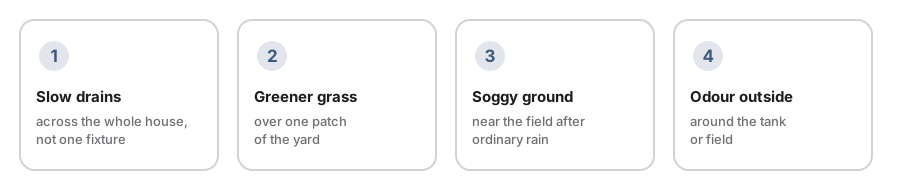
Systems signal trouble long before they quit. Slow or gurgling drains across the whole house rather than at one fixture. A strip of lawn greener than everything around it. Ground over the field staying soft after ordinary rain. An outdoor smell near the tank or trenches. None is proof of failure on its own, and each is far cheaper to check than to ignore.
A few everyday habits quietly cost a system years. Flushed wipes, whatever the packaging claims about breaking down. Bleach and chemical drain cleaners in volume, which kill the bacteria doing the work. Driving or parking on the field, compacting ground and crushing lines. And downspouts or drains aimed at the trenches, flooding a field built only for household flow.
None of these mean disaster on their own. All of them are cheaper to look at than to ignore.
Every job runs the same way, whether it is a routine pump-out or a full installation. Here is the standard you can hold us to.
You get the number before work starts, not after. If we open the lid and find something else going on, we stop, show you, and quote it separately. No surprise line items at the end.
You get a real window and a call if anything shifts. On rural Blount County lots that can be a long drive, so we tell you honestly when we will be there.
Lids seated, ground raked back, no ruts cut across a sloped yard. The only evidence we were there should be a system that works the way it is supposed to.
Maryville is the base, and the service area covers Maryville, Alcoa, and greater Blount County, including the rural stretches along Highways 411 and 321 and the Foothills Parkway corridor. Much of this county is on septic rather than sewer once you leave the city limits, and the systems vary widely in age, design, and how the terrain around them behaves.
Terrain does more work here than in most counties. A lot on a ridge, a lot in a hollow, and a lot on a bench between them can each need a different answer, because slope decides where effluent wants to travel long before soil type gets a vote. It is the main reason a neighbour's system is a poor guide to your own.
Travel time is part of the quote on the far edges of the county, and we will tell you that on the phone rather than adding it to the invoice afterward. If you are just outside the list below, it is still worth calling.

Septic is one of the few contingencies that can quietly derail a closing, and around Blount County it is also one of the most commonly skipped. A standard home inspection does not include the septic system, so unless someone specifically orders a septic inspection, a buyer can close on foothill acreage with a failing field and no idea until the first heavy rain runs it downhill.
Buyers should schedule early in the option period, while there is still room to negotiate. Scope matters as much as timing: tank located and opened, sludge and scum measured, baffles and tees verified, water run to test flow, and the field probed for saturation. Skip the field and only the inexpensive half has been examined.
For sellers, pumping and inspecting before listing removes a common late-stage surprise. A photographed report in hand turns an unknown the buyer's agent can push against into a documented, recently serviced system, and it lets you handle anything small on your own timeline rather than under closing pressure. On the cabin and rental properties near Townsend and Walland, where service history is often missing entirely, that report frequently makes the difference.
Given attention, a septic system is entirely uneventful, which is the point of maintaining one. Pump-out, pre-closing inspection, or a new installation - call (555) 555-5555 for a straight read on what it needs, including when it needs nothing.
Save the number before you need it, Blount County. Septic problems only get more expensive the longer they wait, and on sloped ground they get harder to reach, too.
Tell us what you need and we'll get back to you with a real answer. If it's an active backup or standing water over the field, calling gets you a faster response.
Call: (555) 555-5555
Area: Maryville, TN and Blount County